Sunday, January 27, 2013

Best Website KPI's For Three Different Website Types | The Daily Egg

Best Website KPI's For Three Different Website Types | The Daily Egg

Success Metrics of a Lead Generation Website

If the success of your website hinges on generating leads, you should be monitoring the following four metrics,
KPIDESCRIPTIONNOTES
Overall Lead Generation Rate% of visitors that complete a lead form
Lead form abandonment rate% of visitors that start but don’t complete a lead form Easiest for multi-page forms but Google Analytics Events can be used to measure single page forms as well.
Leads per day/month# of leads over a period of time
Content downloads/requests for more info # of downloads of additional information White papers, demo videos, webinars
Let’s take a deep dive into the fourth success metric in this list.

How to measure content downloads and requests for more information

There are a whole host of ways that visitors to your website could indicate interest that are short of buying from you.
Connecting with you on social networking sites, downloading white papers, watching a demo video or signing up for a webinar just to scratch the surface.  When site visitors take these actions, they are likely to be moving deeper into your sales and marketing funnel.  Therefore, it pays to track, test and optimize these activities on your website.
For cases where you can create a “thank you” or “success” page, you can simply set up a goal page in Google Analytics for tracking purposes as we discussed in the first section on success metrics for a business blog.  In the case of the white paper, you could require a form to be filled out, followed by a redirect to a “success” page where the visitor can click to download the white paper.  This “success” page could be tracked as a goal page in Google Analytics.
But how do you track activities like watching demo videos or downloading documents (PDF, Excel, Word, etc) that don’t reside behind a lead form?
In these cases you can employ the use of Virtual Pageviews or Events in Google Analytics.
Let’s tackle each separately by using an example.

When to use Google Analytics Virtual Pageviews

Documents like spreadsheets, PDF’s or Word documents don’t contain the Google Analytics tracking code.  Therefore you can’t track the number of people that visit these pages.  Not the traditional way anyway.
With virtual pageviews you can configure a link so that, when clicked, will register a page view in Google Analytics.  Here’s more information on setting up a link for a virtual pageview.
So, for example, when a site visitor clicks on a link that downloads a PDF white paper – it could register as a page view in your Google Analytics for a page that doesn’t actually exist.  That’s the virtual part — get it?
You can set these “ghost” pages up as goal pages just as you would any other page on your website.
The main thing to keep in mind is that, when using Virtual Pageviews, you will be increasing the number of page views that Analytics is recording.  In the case where a visitor is literally visiting a page (a PDF in this case) virtual page views makes sense.
But you probably don’t want to use virtual page views if there is not an actual page being viewed.
In those cases, you can set up Events in Google Analytics.

When to use Google Analytics Events

Events can be set as goals as well but, unlike virtual pageviews, Events don’t generate a page view.   In other words, if you don’t want to artificially inflate page views, use Events rather than virtual pageviews.
Google Analytics Events has a wide range of use cases including,
  • Tracking whether (and how much) of a video a visitor watches
  • Interaction with widgets or other gadgets (i.e. a mortgage calculator)
  • Clicks on outbound links
  • File downloads
  • AJAX elements
Here’s an example of Google Analytics Events tracking outbound link clicks on The Daily Egg,
Google Analytics Events Tracking Outbound Link Clicks
You can see why I wouldn’t want to use virtual page views for this.  These 8 Event Actions alone would inflate page views by ~12,000.
If you want to set up a goal using Google Analytics Events, start here.

Measurement will give you a competitive advantage

The George Harrison song lyric that opened this article is inspired by an exchange between the Cheshire Cat and Alice in Lewis Carroll’s famous tale, Alice in Wonderland.
“Would you tell me, please, which way I ought to go from here?”
“That depends a good deal on where you want to get to,” said the Cat.
“I don’t much care where–” said Alice.
“Then it doesn’t matter which way you go,” said the Cat.
It’s one thing to not care where you are headed in a fairy tale — quite another when you are running a business.
But you’re smarter than that.
You know that competition is fierce.  You know that as tools like Google Analytics, Crazy Egg and others get more sophisticated, it will be those that measure, test and optimize their KPI’s that will thrive.
I wish you the very best of luck!
What are the best webiste KPI’s in your opinion?  What kind of website do you have and what metrics do you use to measure success?

Tuesday, December 11, 2012

Headline Formulas That Convert | 7 Examples | The Daily Egg

Headline Formulas That Convert | 7 Examples | The Daily Egg
My wife thinks I am weird.
More on this in a second.
First, understand that the Internet hasn’t changed everything.   The headlines that David Ogilvy and other legendary copywriters wrote for print ads and direct mail in the 1950′s are found in 21st century Twitter and RSS feeds.
The art of writing headlines that convert survived the Internet revolution because it works. And it will always work, because good headlines tap into psychological triggers that are hard-wired into the human mind.
So, assuming the human psyche doesn’t drastically evolve any time soon, committing to learning how to write better headlines is a good investment of your time.

Teri Hatcher is compelling, and so are these headlines

When I see great marketing, I get excited.  And my wife wrinkles her nose and furrows her brow.  She doesn’t get it.
I’m always on the look out for great marketing, and I bet you are too.
My wife gets particularly concerned when I read and study headlines while standing in line at the grocery store. I know, it’s sick.
But you should try it.  Headline writers for print magazines are the best in the world at getting you to take action.
It’s a fantastic exercise.
Consider the following seven headlines from Prevention magazine and the formulas that make them work.
Headlines That Convert

Headline 1 – Shrink Your Fat Zones: Lose 7 Lbs in 7 Days

This headline makes a promise, as all good headlines do. It promises that we will receive a benefit. And it promises that we will receive a desirable quantity of that benefit in a desirable time period.
The Formula
Get [desired result] in [desirable time period]
Examples
  1. Fix Your Poor Eyesight With a Simple 2-Hour Procedure
  2. How To Become Debt Free in 90 Days or Less
  3. Master the German Language in Record Time

Headline 2 – 8 Lies About Sunscreen: Believe Them At Your Own Risk

This headline poses a threat. It gets us to take action because we feel as though we may be putting ourselves or those we love at risk. It also implies that something we trust has misled us and may be dangerous.
The Formula
X Lies About [Something Common]
Examples
  1. X Lies Real Estate Agents Are Telling About the Housing Market
  2. Is Your Veterinarian Being Honest With You About Canine Heartworms?
  3. X Questions That Will Make Your Accountant Squirm in His Chair

Headline 3 – Vegetarian Nation: Will These Women Change The Way You Eat?

This headline works because it (in a sneaky way) demonstrates social proof and then asks a question. Social proof provides someone making a decision the reassurance that others are already doing what you are considering. The term ‘Nation’ at the beginning of the headline indicates that there is an enormous amount of people that are vegetarians. Yes, it is indeed a crafty use of social proof.
Asking a question in the headline automatically makes us more engaged in the headline. If we read the question, we feel compelled to answer it. In order to answer it we must read the content.
The Formula
[Provide social proof] [Ask a compelling question]
Examples
  1. Millions of Dollars Refinanced: Can You Afford To Ignore Changes In Mortgage Rates?
  2. Derek Jeter Trusts Us: Do You Know If You Are A Good Candidate for Lasik Surgery?
  3. Do You Know Why Thousands of Cancer Survivors Gather In Central Park Every October?

Headline 4 – The No Pill Pain Remedy Doctors Now Trust

This is a good headline formula if your audience is skeptical of the benefits your product provides. Your product might be new and unfamiliar to your audience. Or, it may have received poor reviews in the past.
The headline works because you are declaring that a trusted group of people now endorse the product.
The Formula
The [previously untrusted or unproven product] That [authoritative person/group of people] Now Endorse
Examples
  1. The Emerging Trend In Skin Care That Julia Roberts Swears By
  2. A New Way To Talk Business: Why Every IBM’er Is Now Using Android Mobile Phones
  3. The Water Substitute Thousands of Fitness Trainers Are Using To Hydrate

Headline 5 – Vacation Perils & Pitfalls: Banish Bedbugs, Bach Strain, Belly Aches and More

This is another threat headline. It makes a promise that if we read the article we can avoid some of the awful things that can ruin a vacation. The headline also takes advantage of the idea that people will do more to avoid pain than to seek pleasure.
The Formula
[Threat] + [Promise of a solution]
Examples
  1. 7 Legal Cheats That Keep The IRS Out Of Your Pocketbook
  2. Sidestep A Leaky Basement In 5 Easy Steps
  3. Insurance Nightmare: A Natural Disaster Checklist To Review With Your Agent

Headline 6 – Beat The Sunday Night Blues: Surprising Ways To Put The Fun Back In Your Weekend

This headline uses a word that will perk up your ears. Can you guess what it is?
Surprising.
The word surprising in this headline is critical because it communicates that these are not the ordinary suggestions we always hear about having fun on the weekend. These are new or, at least, new to us.
The Formula
[undesired result] + [mysterious solution]
Examples
  1. How To Avoid Public Embarrassment: A Professional Speakers Secret Revealed
  2. 17 Little Known Email Hacks That Keep You Out of Productivity Hell
  3. A Misunderstood Home Remedy For Reducing Heart Disease

Headline 7 – Teri Hatcher: Her Shocking Struggle With Secret Pain

People like to hear juicy details about the people they admire and respect. This headline uses some very powerful words including shocking and secret. If we are even mildly interested in the person they are referencing, curiosity forces us to take a look.
It also exploits our desire for new information. Something we haven’t heard before.
The Formula
[respected person/group of people] + [exclusive/new information]
Examples
  • Steve Jobs Reveals All About Apple’s Revolutionary Design Process
  • A Fresh Look At An Ancient Problem: How Los Angeles City Planners Overcame The Energy Crisis
  • A Behind The Scenes Look At The Latest Technologies in Movie Making

Will you use your powers for good or evil?

Writing good headlines is not, in and of itself, manipulative. That being said, you don’t have to look far to find a great headline with nothing behind it.
There is no better way to alienate people than to make a promise in a headline and fail to deliver on it. Writing headlines that don’t deliver is not just ethically wrong. It’s also bad business.
Study great headlines.  Put them (ethically) into practice for your business.  You will find that your spouse thinking you are weird is a small price to pay.

Friday, October 26, 2012

Landing Page Hot Spots | Take Advantage of Landing Page Hot Spots | The Daily Egg

Landing Page Hot Spots | Take Advantage of Landing Page Hot Spots | The Daily Egg: Google

There are a handful of landing page elements that never fail to draw a visitor’s attention.
If you take full advantage of these “hot spots”, you can create a more engaging landing page.
What are these hot spots?
Here are five:

#1 – The Hero Shot

The “hero shot” is a large, high quality image of your product.
In the case of services and other intangibles, the hero shot may show the ideal end result your customer desires.
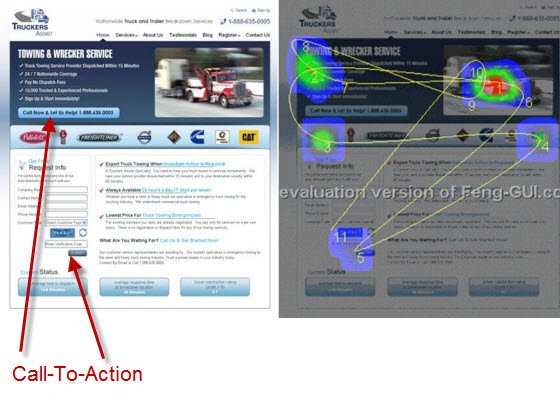
In this example from Techwyse, the data from Feng-Gui, an automated attention analysis tool, shows that the hero shot draws and holds the attention of the visitor while the calls-to-action are ignored.
Hero Image
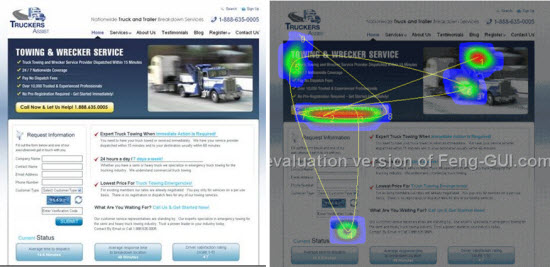
Changing the color of the hero shot to blue (to blend in) and the calls-to-action to yellow had the desired effect.
Notice that the hero image grabs attention but doesn’t hold it, causing the eye to move and engage with the primary call-to-action.
But automated tools like Feng Gui should be just one tool in your landing page optimization toolbox.
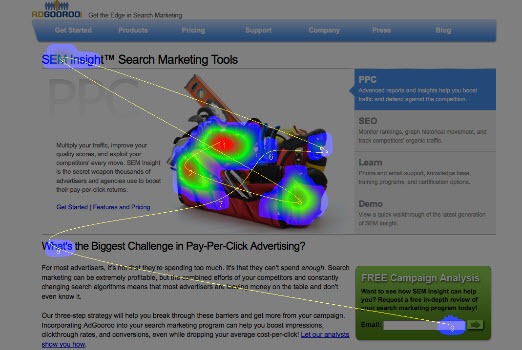
In this example from AdGooroo, the Feng-Gui tool determined that the hero image was holding the attention of the visitor, causing the page to perform badly.
Ad Gooroo
If the story ended there, this photo would just be a distraction.
This is click data from the Crazy Egg heatmap tool on this same landing page.  This data, plus analytics showing a 38% click-through on this page disprove the theory that the hero shot is distracting.
Source: AdGooroo.com, “Why we have a 38% Clickthrough Rate“
Having a hero shot by itself is a great way to attract attention, but it will mean almost nothing for your conversions if this attention isn’t directed towards action.

#2 – The First 3 Bullet Points

Images from: Marketing Sherpa
In Jakob Nielsen’s study, “F-Shaped Pattern For Reading Web Content”, readers noticed bullet points as they scanned down the left side of web pages. This makes bullet points a useful form for simply listing the features and benefits of your products.
When using bullet points, however, make sure that you don’t bury the most important features. Once you’ve identified the features and benefits that are most important to your customers, list these first. As these heatmaps from Marketing Sherpa show, visitors tend to look at bullet points in the product copy, especially the first 2 to 3 points.

#3 – White Space

Images from Strategic-planet.com, “Visually Optimise Your Websites and Adverts“
It’s tempting to fill every single pixel of your landing pages with text or graphics, but just because a space is empty it doesn’t mean that it isn’t useful.
White space or negative space helps focus your visitors’ attention on the important elements. For example, this usability study shows how the presence of margins in textleads people to read text more slowly and increases their comprehension of the text.
The use of white space may also improve the chances of having your landing page copy read. According to this study from Strategic Planet, changing a poster’s background color to white led viewers to read the text. So if you have important text that needs to be read, such as in a sales letter or landing page copy, it makes sense to test them on a white background.

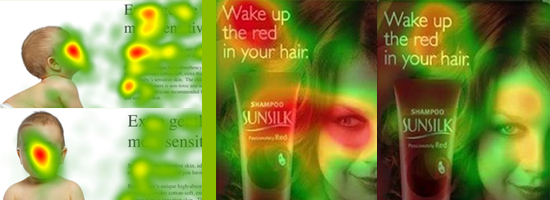
#4 – The Subject’s Line of Sight

Images from Think Eye Tracking and Usable World

We are quickly drawn to human faces, especially eye gaze. Studies from Think Eye Trafficand Usable World also demonstrate that viewers look in the same direction where the photo subjects look. This means that if you’re going to add photos of human faces in your landing page, these photos will draw a lot of attention.
Redirect your reader back to the copy, call to action, or the product by directing the subject’s gaze in the same direction you would like your visitors eye to follow.

#5 – The Singular CTA

Images from Landing Pages Showcase
Finally, one of the major hot spots of your landing page is your most prominent call to action.
The natural eyepath of your visitors should land on this call to action if you want them to take that action.
Visitors that are trying to solve a problem are intuitively drawn to the call-to-actin.  Their eyes and their clicks tend to flow towards forms, large buttons, and links. The fewer calls to action you have, and the more prominent they are on the page, the easier it will be for your visitor to find them.
Do you use any of these hot spots in your landing pages? What effect did they have on your website visitors’ actions?

Thursday, October 25, 2012

20 Power Words In Online Advertising | The Daily Egg

20 Power Words In Online Advertising | The Daily Egg

A recent Interactive Advertising Bureau (IAB) study revealed that online advertising accounted for 3.7 percent of the United States’ gross domestic product (GDP) in 2011.
At a loss for words? It could be the case that your ads are too.
Marketers are competing with millions of other advertisers for audience eyes. Website visitors see a lot of online advertisements, and unless you’re paying attention to the subtleties in your copy, your efforts may go unnoticed.
If you’re struggling to find the right words, here are 20 to kickstart your brainstorming. No thesaurus necessary.

1. You

Think of your ads as the first handshake between your brand and your potential customers.
From the very first moment, you want to form connections with the people you want to reach  – and keep in mind, your potential customers are likely in a “what’s in it for me?” mindset.
If you start the conversation by focusing on yourself, the people you’re trying to reach aren’t going to listen. So make your ad about your audience. Anytime you’re using the word “we” or “I,” think about whether you can substitute the word “you.” From a psychological standpoint, those simple three letters are invaluable for helping build connections.

2. Click

But that’s obvious, right? People know that they’re supposed to click!
Wrong.
The Internet is full of a range of user types, and to some (like people who didn’t grow up online), a “click” is not an obvious action to take. If you say “start browsing now,” for instance, people might do just that  – browse without actually engaging with your brand.
Instead, say “click to start browsing now.”
Note: If you’re not sure whether your on-site advertisements or landing pages are confusing people, consider running a test with a tool like CrazyEgg to see where people are and are not clicking.

3. Free

Eventually, they might be willing to spend money, but at first, they’ll need some kind of incentive.
If you have a free incentive to offer – by all means – highlight that information from the get-go in your advertisement.

4. Increase

This word is an absolute must for B2B advertisements.
When decision makers look for products, they are looking for a lift in ROI or productivity. This word highlights how your product provides tangible value.
Are you increasing sales? Conversions?  Intelligence?  Time with family?  When advertising your company, make sure that you emphasize what you have the power to transform. Case in point below:

5. Try

The word “buy” can sometimes appear aggressive, test something softer.  One variation is the the word “try.”  Use it to connect with users who may not be ready to bust out their credit cards and start spending.
“Try” is a word that’s motivating and action-oriented, but it won’t overwhelm people who aren’t quite ready to commit.

6. Opportunity

Chances are that your target audience has some kind of goal that they’d like to reach.
Give them the “opportunity” they’ve been wanting. Are you advertising a career opportunity? A business opportunity? An educational or networking opportunity?

7. Ends

Are you advertising a promotion that ends on a specific date? If so, include that information – a concrete deadline is invaluable for inspiring people to take action.

8. Learn

Like #5 (try), this word will help you get click-throughs from people who are interested in your product but may not be ready to buy.
You’re aiming to reach people who are in the research stage of the sales cycle.
Check out the following example from StudioPress:

9. Easiest

Consumers and decision makers want products that make their lives easier.  They don’t want the hassle of something complicated.
If your product or service has the potential to make a task easier, then advertise that selling point – people will be happy to drop what they’re doing and listen to what you have to say.
Consider the following example from the KISSmetrics homepage:

10. Find

When customers research a product, they are likely hoping to find an answer to a specific question.
The word “find” is solutions-driven in the sense that it is a key step to solving business puzzles. Check out the following example from UserTesting.

11. Grow

Especially if you’re a B2B marketer, your customer base will want their business to grow.
If your product and service can help support that effort, let your audience know from the get-go.
What’s even better is if, in the ad itself, you can explain how your product or service promotes growth  – or if you can talk to a niche audience.
Have a look at the Constant Contact Google AdWords ad below:

12. Love

When it comes to sales, emotions are a powerful force.
Don’t just give audiences something they’ll like – sell them a product they’ll love. Make them feel as valued as possible for supporting your business.

13. Compare

Does your company’s rates or offerings completely rock compared to your competitors? 
If so, challenge your prospective customers to run their own comparison. By using this word, you’ll be showing confidence in your ability to stand behind your brand.
You’ll empower customers to make their own decisions and form conclusions about why your company provides the absolute best. ]
Not convinced? Compare the following Charles Schwab ad with some others that you’ve seen.

14.  Time

There’s never enough of it, right?
If you can demonstrate that your product or service is able to save time, audiences will will be drawn to your offer. More so than money sometimes, time is a valuable asset.
Check out the following example from Fidelity.

15. Don’t

This mono-syllabic word of caution will stop people in their tracks.
Use this word if you’re looking for a quick attention grabber, but don’t get too bogged down by a negative statement. Keep your “don’t” phrases short and sweet. “Don’t forget” and “don’t miss out” are just a few of the ways to use this power word.
Use the word to help guide people to a decision that they won’t regret.

16. Exclusive

The “velvet rope” is a powerful metaphor.
If you are making offers to certain segments of your market only, let them know it.
Keep your advertising honest by ensuring that your offer is actually exclusive.
Check out the following example from Banana Republic with an offer for Twiter Moms:

17. Fast

Right from the beginning, advertise your brand as one that prioritizes promptness.
Nobody wants to wait to see the benefits of their brand new purchase. Whether you’re hoping to appeal to business or consumer brands, show that you’re committed to quick turnaround.

18. Unique

By using this word, you’ll generate a sense of allure that will catch peoples’ attention.
What makes your products stand out from the crowd? If you have a unique product or ‘secret sauce’ worth offering, let your customers know.

19. Start

Why wait around when you can start now?
On a subconscious level, this word will get customers thinking about taking that next step. It’s a word that motivates people to do more than sit there and stare. Inspire your ad viewers to take action now. Start your analysis with the following SurveyMonkey ad.

20. Be

This word is as versatile as it is inspiring.  It conjures images of transformation.
Be your best. Be better than your best. Be your own boss. Be a leader.
It’s a very simple word with powerful applications from education to careers and business.

Final Thoughts

There you have it – 20 words that you need to use in your ads.
Notice that all of these words are super simple, conversational, and easy to follow.

Three Testing Strategies For Sophomore Conversion Testers | The Daily Egg

Three Testing Strategies For Sophomore Conversion Testers | The Daily Egg

Change the color of your call-to-action button.  Test a new headline.  Swap this hero image for that hero image.
Been there, done that.
Try these three conversion testing methods for Conversion Testing sophomores.

#1 – Blow it up, start from scratch

Instead of pursuing split tests on specific site elements – such as the headline or call-to-action button – 37signals decided to test two fundamentally different versions of theirHighrise homepage. The rationale behind this was that they needed to destroy their assumptions about what may or may not work.
Almost everything was different about each version.
This is an image of the Original Design vs. the Person Design:
  • The Original Design had several smaller customer photos, while the Person Design had one large background photo of just a single customer.
  • There were several customer testimonials in the Original Design, while the Person Design only had a single quote from the featured customer.
  • Only a handful of benefits are listed on the Person Design, while several features and benefits are outlined in the Original Design.
  • The person design has only one prominent call-to-action: “See Highrise Plans and Pricing”. The Original Design had a navigation menu, as well as options to view more testimonials and features.
The result of this difference was that the Person Design led to a 102.5% increase in paid sign-ups.
Key Takeaway: Rather than just testing small elements of your landing page, try to test radically different versions of the page.

#2 – Remove something “essential”

We all want our websites to have clear navigation – this makes it easier for visitors to browse our websites.
But does this make sense for all situations?
According to this test conducted for Yuppiechef, eliminating your navigation menu may help increase conversions. In their case, the increase was at 100%.
Why did this work? Having the navigation menu on their landing page distracted visitors from the primary call to action.
With too many options for what to do next, the visitor may be overwhelmed. Or they may attempt to manually find the information they need. Letting your users roam may be fine for most of your information pages or your blog, but sometimes it’s best to carefully direct these users to perform specific actions.
While this doesn’t mean abandoning notions of easier site navigation, it’s important to minimize other potential visitor actions on landing pages where your conversions matter the most.
Key Takeaway: Some items that may seem necessary, such as your navigation menu, could be getting in the way of higher conversions.

#3 – Test the audience, not the page

It’s simple to just test page elements, but how about testing which audience segments are most profitable? This is what Art Beads did during their holiday promo. Unlike the previous examples, this test was conducted via an email marketing campaign rather than a website.
While Art Beads could have sent a blast promo emails to their entire list, doing so made no sense for their business in the long run. A large scale campaign like this meant that their customers might expect discounts all the time.
Their solution? Find and test more profitable segments from their existing customer list. They identified that segment as current email subscribers who made only 1 purchase in the past 18 months – yet that purchase had to rank among the top 25% in value within the same period.
They ended up with a conversion rate 208% higher than their large-scale email blasts.
Key Takeaway: Increasing conversions doesn’t necessarily mean changing an element of your business or website. You can also try changing the customer segment you’re selling to.